

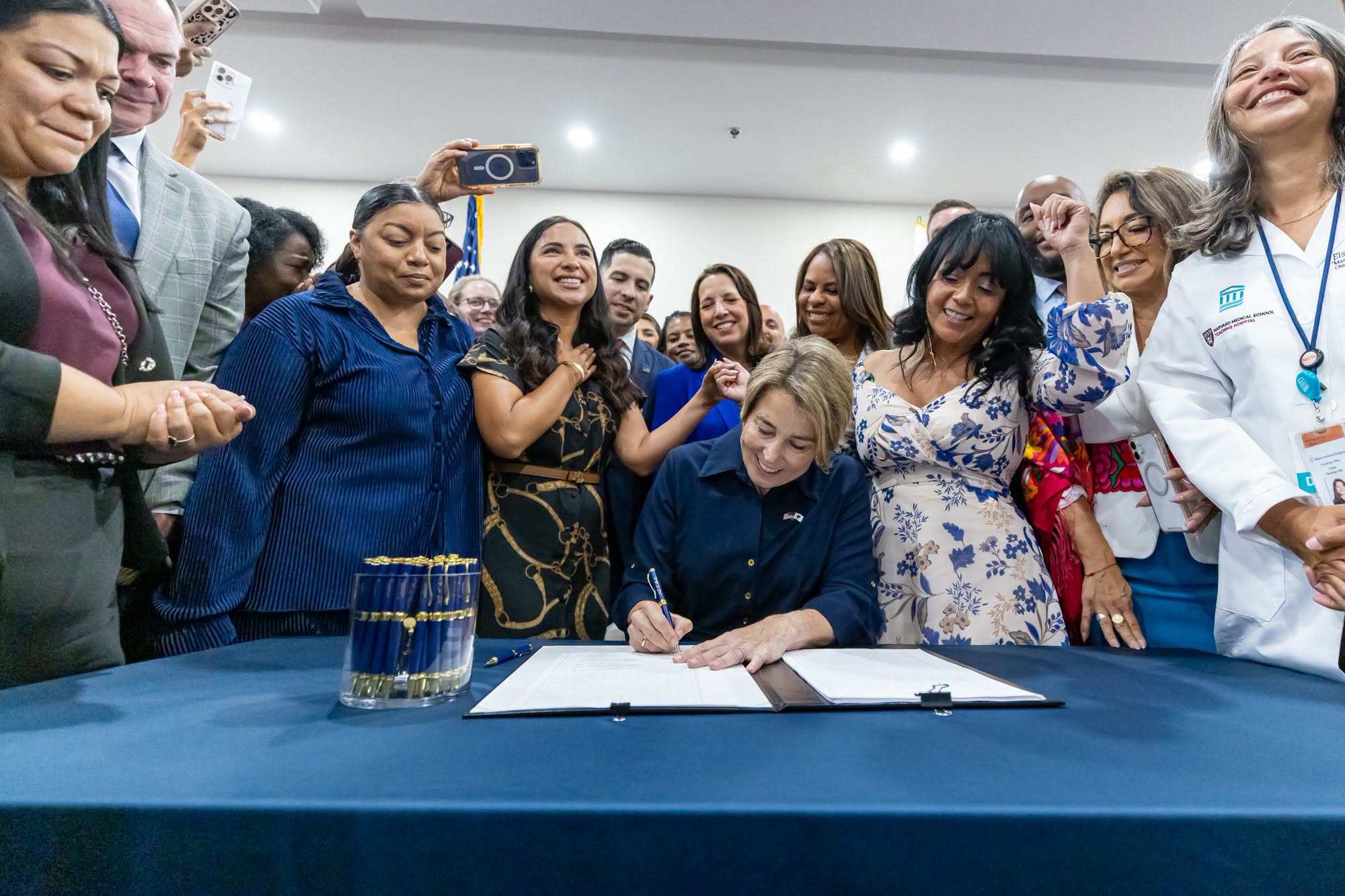
Massachusetts Governor Maura Healey signed the PROTECT Act into law on August 5, 2026, describing it as the strongest state-level protection against Immigration and Customs Enforcement (ICE) practices in the country. The law limits certain ICE activities in schools, child care centers, hospitals, health care facilities, nursing homes, and courthouses, while also expanding legal protections for immigrants and their families. [mass.gov], [cbsnews.com], [upi.com]
The legislation has been praised by immigrant advocates and strongly criticized by supporters of stricter immigration enforcement. Understanding who benefits, who may be disadvantaged, and the reasoning behind the law helps explain why it has become one of the most significant immigration policy debates in Massachusetts.
Who Benefits?
1. Immigrant Families
The primary beneficiaries are undocumented immigrants and mixed-status families who fear detention or deportation.
Supporters argue that many families avoid schools, hospitals, and courts because they worry about encounters with immigration authorities. The PROTECT Act seeks to remove that fear by limiting warrantless immigration arrests in sensitive locations and by restricting certain forms of cooperation between state entities and ICE. The law also allows parents to arrange guardianship plans for their children if they are detained or deported. [mass.gov], [cbsnews.com]
Advocates believe this will lead to greater school attendance, better health outcomes, and more family stability. [cbsnews.com], [mass.gov]
2. Public Schools
According to Gov. Healey, some communities have seen declining school attendance due to fears of immigration enforcement. State leaders argue that children should be able to attend school regardless of their family’s immigration status. The law is intended to reassure parents that schools remain places of learning rather than enforcement. [cbsnews.com], [mass.gov]
Supporters say keeping children in school benefits not only immigrant families but also educators and communities.
3. Health Care Providers and Patients
Hospitals, community health centers, nursing homes, and other medical facilities receive additional protections under the law. Supporters argue that fear of arrest can discourage people from obtaining medical care, resulting in untreated illnesses and broader public health concerns. [mass.gov], [cbsnews.com]
Health professionals who supported the legislation contend that patients should feel comfortable seeking treatment without fear of immigration consequences. [mass.gov]
4. Crime Victims and Witnesses
A major argument behind the PROTECT Act concerns public safety.
Supporters say that when victims or witnesses fear being detained by immigration authorities at courthouses, they may refuse to cooperate with law enforcement or prosecutors. This can lead to weaker cases and, in some situations, dismissed prosecutions. The law is designed to encourage victims and witnesses to report crimes and participate in legal proceedings. [cbsnews.com], [mass.gov], [upi.com]
Who May Not Benefit?
1. ICE and Federal Immigration Enforcement Agencies
The most obvious institution affected is ICE itself.
The law places new limits on how federal immigration authorities interact with certain state facilities and restricts new cooperation agreements known as 287(g) partnerships between state agencies and ICE. Critics argue this makes immigration enforcement more difficult and creates additional legal barriers for federal agents. [mass.gov], [upi.com]
2. Advocates of Stronger Immigration Enforcement
Organizations and individuals who favor aggressive immigration enforcement view the law negatively.
The Department of Homeland Security criticized the legislation, arguing it could hinder cooperation between local law enforcement and federal authorities. DHS officials contend that reducing such cooperation may make it harder to identify and remove individuals accused or convicted of serious crimes. [cbsnews.com]
For these critics, the law prioritizes immigration protections over enforcement and could complicate public safety efforts.
3. Local Officials Seeking Federal Partnerships
Some local law enforcement leaders who support closer cooperation with federal immigration agencies may view the law as limiting their options.
Because the legislation restricts certain formal partnerships with ICE, municipalities that favor direct collaboration may find their authority reduced under state law. [mass.gov], [upi.com]
Why Was the Law Created?
The Supporters’ Reasoning
Supporters argue that immigration enforcement should not interfere with essential public institutions.
Their central claim is that schools, hospitals, and courts function best when everyone feels safe using them. If parents avoid schools, patients avoid doctors, or witnesses avoid court appearances because of fear of detention, supporters believe entire communities become less safe and less healthy. [cbsnews.com], [mass.gov], [upi.com]
Gov. Healey described the measure as a public safety law rather than simply an immigration law, arguing that trust between communities and public institutions is essential. [cbsnews.com], [upi.com]
The Critics’ Reasoning
Opponents believe the law weakens immigration enforcement and creates obstacles for federal authorities.
They argue that cooperation between local and federal agencies helps identify individuals who may pose public safety risks. Critics say limiting that cooperation could force ICE to conduct more visible enforcement operations and make it harder to apprehend people facing deportation proceedings. [cbsnews.com]
From this perspective, the law may protect some immigrants but does so at the expense of effective enforcement of federal immigration laws.
The Bottom Line
The PROTECT Act is fundamentally about balancing two competing priorities: community trust and immigration enforcement. Supporters believe the law protects families, students, patients, and crime victims by keeping ICE out of sensitive public spaces and encouraging people to engage with schools, health care providers, and the justice system. [mass.gov], [cbsnews.com], [upi.com]
Critics argue that the same provisions make it harder for federal authorities to enforce immigration laws and could reduce cooperation between state and federal agencies. [cbsnews.com], [upi.com]
Whether the law ultimately improves public safety or complicates enforcement will likely remain the central question as Massachusetts implements the PROTECT Act in the months and years ahead. [mass.gov], [upi.com]
Dr. Brian Omolo is an author and professional advisor dedicated to raising the voices of the different communities of New England. He is a PhD holder in Literature from Kenyatta University and a bachelor's degree holder in Pure Mathematics from the University of Nairobi, which justifies his combination of analytical clarity and creative insight.